
Growth & Scaling
How to Create a Competency Matrix for Talent Management
Guide to crafting competency matrices for effective talent management.

Lead Talent Partner · Matchr

Businesses are always searching for effective ways to attract top talent and motivate employees. A competency matrix is one such tool that provides a structured approach to evaluating and managing talent. It offers organizations a clear, realistic understanding of employee capabilities, which is especially valuable in a rapidly changing and competitive environment.
Unlike a skills matrix, which focuses on cataloging hard and soft skills, a competency matrix goes further by incorporating the 360-degree feedback method. This method gathers insights from colleagues, managers, and other stakeholders, offering a comprehensive view of an employee’s abilities. By using this feedback, organizations can uncover hidden strengths and talents, helping employees explore new opportunities and contribute to different projects.
This article is meant for recruitment professionals, HR specialists, organizational leaders, and anyone interested in understanding their strengths and areas for improvement to grow their career.
Beneficial Impact of Competency Matrix
Hiring the Right Person
When it comes to recruitment, a competency matrix serves as a valuable tool for identifying the specific skills and qualifications required for a given role. By clearly defining the competencies needed for success in a position, hiring managers can tailor job descriptions, screening criteria, and interview questions to ensure they attract candidates who possess the necessary skills and attributes.
Additionally, it can help candidates prepare for challenging competency-based interviews at companies that encourage applicants to use STAR (Situation, Task, Action, Result) or PARLA (Problem, Action, Result, Learning, Application) methods. These approaches are geared towards fully unpacking candidates’ background and tapping into their potential, which can be immensely beneficial for the company.
Identifying Missing Gaps
One of the primary benefits of a competency matrix is its ability to highlight gaps in the skills and knowledge of individual employees or the entire team. By comparing the desired competencies for a role with the current skill set of employees, managers can identify areas where additional training or development initiatives may be needed to bridge these gaps. Addressing these deficiencies proactively can help ensure that the team is equipped to meet current and future challenges effectively.
Employee Motivation and Optimized Personalizing Training
By leveraging insights from a competency matrix, organizations can optimize their training and development programs to target the specific needs of employees. This involves identifying the critical skills and competencies necessary for individual roles or career paths and tailoring training initiatives accordingly. Such a personalized approach not only enhances the effectiveness of training programs but also boosts employee engagement and satisfaction by addressing areas directly relevant to their roles and career aspirations.
Additionally, transparent grading criteria and requirements provided by the competency matrix can further motivate employees, increasing their productivity and overall performance. This clarity makes it easier for professionals to strive towards tangible goals, rather than vague notions of “potential career growth.”
Identifying Hidden Skills
In addition to assessing existing competencies, a competency matrix can also uncover hidden skills and talents within the workforce. By systematically cataloging employees’ skills and experiences, managers may discover that certain individuals possess valuable capabilities that were previously unrecognized or underutilized. Leveraging these hidden skills can lead to new opportunities for innovation, collaboration, and professional growth within the organization.
Effective Resource Allocation
Company managers can evenly assign employees to different projects, taking into account their developed skills. This prevents situations where all the best experts are allocated to one team, weakening other areas.
Balancing Skills within the Team
It helps avoid scenarios where key competencies are concentrated in one employee. In case of illness or departure of such employees, there’s a high risk of losing critical skills and reducing the team’s performance.
How To Create a Competency Matrix
Creating a competency matrix is no small feat. In practice, there are three main methods for developing such a document:
- DIY (Do-It-Yourself) Approach: This method, while the most time-consuming, is characterized by a high degree of objectivity. Company executives or specific departments, rather than just leaning on HR or Recruitment departments, are responsible for creating the matrix. This involves observing employees, identifying key qualities, calculating effectiveness, and more. Based on this data, a matrix is formulated for each specialist.
- Ready-Made Templates: Countless competency matrices are available online, ready for use. For example, the international company Miro, specializing in dashboards, has developed its own template. However, it’s important to remember that each template was created without consideration for the specific characteristics of a company. Therefore, it’s not recommended to use a found model “off the shelf” without modifications and adaptation. Ideally, these examples should be used as reference material for developing your own model. Additionally, some companies themselves distribute lists of competencies needed for certain roles. For instance, Ryan Peterman (Staff Software Engineer @ Instagram) shares in his blog how grades and competencies differ in technical giants like Meta, Microsoft, Google, and Amazon, where he has worked.
- Outsourcing: This option is for executives who don’t have the time to research processes and analyze employee performance. In this case, an external company handles the development of the competency matrix, engaging an expert consultant to adapt the matrix to the company’s requirements. However, several factors should be considered here. Does the consultant understand the business specifics, not to mention company’s values and culture?
Anyway the choice of the method depends on lots of factors. Unlike larger corporations with established HR or Recruitment departments, startups and mid-sized companies often lack the resources or budget to invest in outsourcing such tasks. Despite the fact the process is quite time-consuming, internal stakeholders have a deeper understanding of the company’s unique needs, culture, and values, allowing for a more tailored approach to competency assessment.
The DIY method fosters a sense of ownership and accountability within the organization, as stakeholders actively participate in the development process. This level of involvement can lead to more accurate and relevant competency matrices that align closely with the company’s goals and objectives. Moreover, the DIY approach allows for greater flexibility and customization, as the matrix can be continually refined and adapted as the business evolves.
Competency matrices for Engineering Department at top world-known tech companies:
- Soundcloud
- Wise
- GitLab
- Dropbox
- Klarna competencies & Klarna levels
- Circle CI competency matrix & Guidelines
Visual Examples of Competency Matrices
Visual representations of competency matrices serve as powerful tools for organizations to effectively reflect the current state of things. Though there’s no one-size-fits-all template, competency matrices can be created with the help of various tools and platforms. So let’s look at a couple of possible approaches to presenting competency matrices visually.
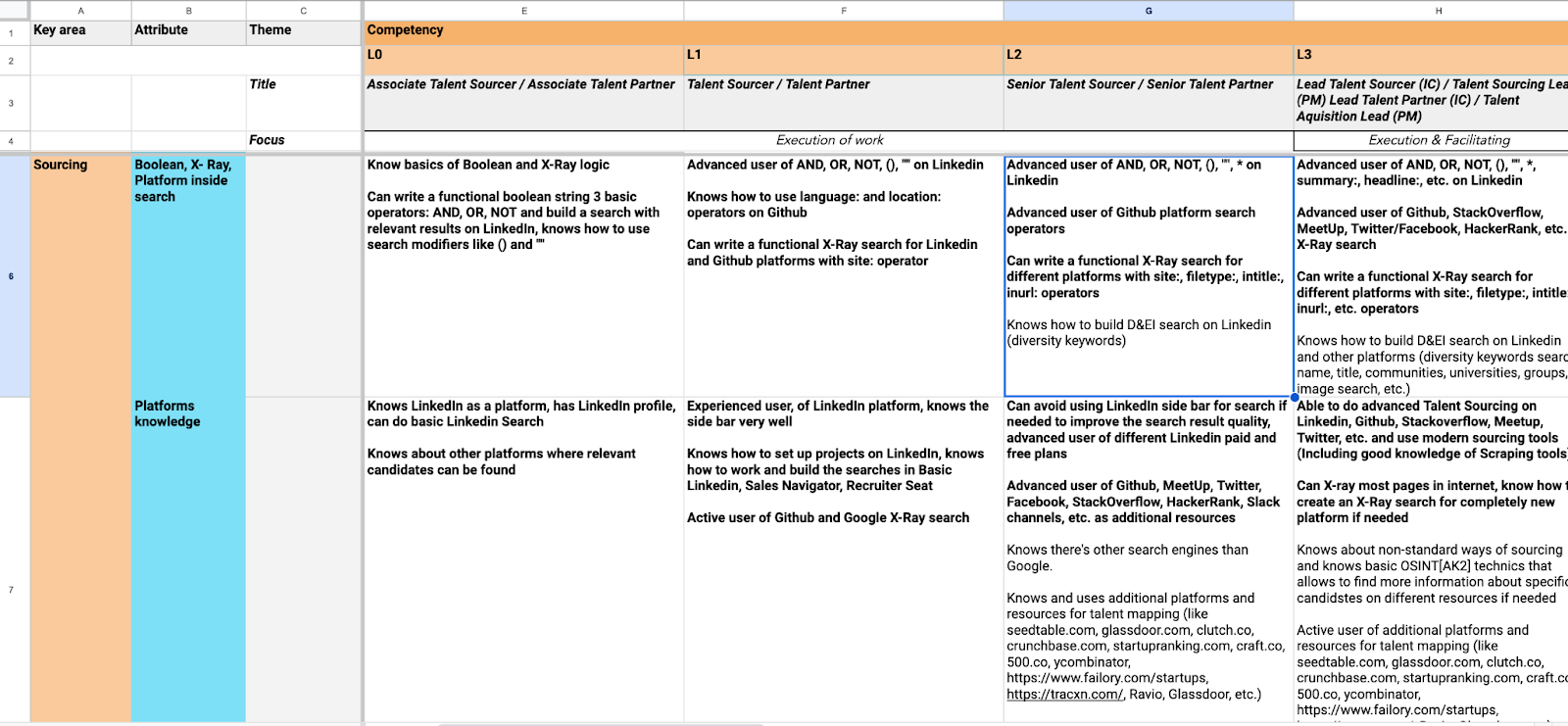
Competency matrix grid for Associate Talent Sourcer / Associate Talent Partner at Matchr (Excel)
Competency Matrix presented as a circle diagram
Flowchart mapping
Fishbone diagram
Finally you can check levels.fyi, a platform that offers insights into Software Engineering (SWE) levels at various companies. It provides details on salary ranges and unique aspects of skills and competencies within a range of departments. Some features are free and others are available by subscription.
Creating a Competency Matrix: Who Does What
Creating a competency matrix from the ground up is quite a task, but with the right project team, it’s entirely feasible within a company. Typically, this team should consist of supervisors and coworkers who often interact with the position for which the competency matrix is being designed.It’s not limited by professionals from HR or Recruitment but involves any team (engineering, product, marketing, data, etc.) requiring comprehensive competency matrix.
It’s also recommended to appoint a project team leader who can outline the document’s objectives, devise an action plan, assign responsibilities, and oversee timelines.
Recruitment / HR team
Initiate the process by compiling the initial list of competencies for the role. Assist in formulating competency indicators, assessment scales, and adapting the matrix for practical use.
Leaders / Managers
Help adjust the list of competencies and their indicators considering the goals, tasks, and nuances of the role.
Technical or other “field” experts
Jump in to make sure the hard skills being assessed line up with market realities.
The L&D and/or HR Specialist
Take the matrix and tailors it for internal use, whether it’s for onboarding new hires, developing employee training programs, or conducting regular performance reviews.
Steps in Crafting Competency Matrix
Step 1. Developing an effective competency matrix relies on several critical factors
Firstly, gathering and analyzing information is essential. Stakeholders must unite to ensure a cohesive vision and sidestep conflicts. Secondly, establishing a clear purpose and goals is vital. Defining the matrix’s objectives guides its development, ensuring alignment with company’s goals.
Open communication and collaboration are not less essential. Engaging various team members fosters diverse perspectives and consensus-building before matrix creation. Clarity on the matrix’s purpose is crucial for organizational alignment. Gathering information from various sources enriches the matrix’s depth and accuracy.
Furthermore, considering end-users throughout the process is essential. Understanding their needs and adjusting the matrix accordingly ensures its effectiveness. Surveys or interviews with potential users offer valuable insights to tailor the matrix to their requirements. In summary, crafting a competency matrix demands planning, teamwork, and meticulous attention to detail. By adhering to these guidelines, you’ll create a potent tool for enhancing employee skills and organizational success.
Step 2. Defining key competencies is pivotal in crafting a competency matrix
A project lead must grasp several aspects:
- The specific role for which the matrix is being created.
- The employee’s goals in this role.
- The tasks the specialist performs or will perform if not already onboarded.
- The skills and qualities required to tackle these tasks.
The initial crafting demands a thorough understanding of the company’s overarching objectives. Consulting with both the hiring manager and team lead offers valuable insights into the role. Engaging with the department head, especially if similar roles exist, enriches the understanding of the ideal employee profile.
As we all know information is useless if it’s not supported by data. So guided by market research and internal insights, the recruiter can effectively develop a preliminary list of role-specific skills. After this the list undergoes inspection by the project team to refine and eliminate redundancies. However, diverse viewpoints may arise, with each party advocating for their priorities. For instance, the hiring manager may push for a comprehensive skill set, envisioning an ideal candidate. Resolving such discrepancies involves aligning with the company’s goals and the specific challenges of the role.
To streamline the competency list, it’s also crucial to present current market situation, including candidate availability, volume of the talent pool, and assessment timeframes. Be aware that lengthy interview processes are often met with resistance, underscoring the importance of a focused and efficient competency framework.
Step 3. Creating guidelines
If you’ve truly arrived at the point where you need a competency matrix and are ready to implement it as a new tool, don’t overlook the importance of preparing guidelines for its use. It will likely be a voluminous document customized for each role and grade. And many end-users may be encountering this new detailed assessment system for the first time.
Step 4. Regular synch-up
This tool requires regular checks, adjustments, and improvements because with the growth or, conversely, the reduction of the team, the capacity of the talent pool will change. Competency matrix reflects the both positive and negative dynamics of the company and requires constant attention and reshaping.
The List of Competencies in the Competency Matrix
While compiling the matrix, remember not to overcomplicate its content – make it clear and concise. The aim of any matrix is to ensure the usability by anyone in the company. So let’s look at some core competencies that one can come across designing your own tool.
- Creativity: Coming up with innovative ideas to tackle challenges.
- Adaptability: Navigating smoothly through changes and thriving in diverse environments.
- Empathy: Understanding and connecting with others, considering their perspectives.
- Analytical Thinking: Breaking down complex problems, analyzing data, and making informed decisions.
- Collaborativeness: Working seamlessly with diverse teams to achieve common goals.
- Resilience: Bouncing back from setbacks and maintaining a positive outlook.
- Excellent Communication: Expressing thoughts clearly, actively listening, and fostering effective dialogue.
- Ability to Persuade: Influencing others to adopt new ideas or perspectives.
- Negotiation: Finding common ground and reaching mutually beneficial agreements.
- Goal Orientation: Staying focused on achieving objectives and driving results.
- Customer Focus: Putting customers at the forefront, understanding their needs, and delivering value.
- Problem-Solving: Tackling challenges creatively and finding practical solutions.
- Attention to Detail: Noticing the finer points, avoiding errors, and ensuring precision.
- Continuous Learning: Actively seeking opportunities to acquire new knowledge and skills.
- Adaptability: Adjusting swiftly to evolving situations and embracing change.
- Leadership: Guiding and motivating others toward common goals.
- Strategic Thinking: Planning and executing with the big picture in mind.
- Decision-Making: Making sound judgments based on analysis and consideration.
- Conflict Resolution: Addressing and resolving disagreements to maintain harmony.
- Time Management: Efficiently organizing and utilizing time to meet deadlines.
- Ethical Behavior: Upholding moral principles and integrity in all actions.
- Data Literacy: Understanding and interpreting data to inform decisions.
- Technical Expertise: Knowledge, skills, and proficiency in a specific technical field or discipline.
You already know that competencies are like the must-have skills, know-how, and behaviors you need to rock a job. Indicators, on the other hand, are specific behaviors, actions, or outcomes that demonstrate the presence or level of proficiency in a particular competency. They provide tangible evidence of how competencies are exhibited in the workplace context. Indicators help assess and measure an individual’s competency level objectively.
Defining Benchmark Indicators
Usually, a competency matrix consists of two main parts: a list of competencies and an assessment scale. The format of the scale can vary, sometimes presented as a table or a diagram, allowing you to identify standout competencies within the team and areas that may require improvement. Competencies can be assessed using different methods, such as specific indicators,text descriptions, a 100-point or 5-point scale, proficiency levels (from entry-level to expert), classes (from A to C), and more. If desired, you can always create your unique evaluation system. The key is to ensure consistency for each employee and skill, as without it, adequate analytics cannot be achieved.
When embarking on the search, recruiters often keep an ideal candidate profile in mind, crafted based on the matrix. However, remember that the matrix serves as a map and guide for investigating the market. Avoid getting fixated on specific employee criteria. Sometimes, advanced soft skills and high potential can outweigh a deficiency in hard skills.
Exercise caution in the overall assessment as well. A candidate who scores maximum on most competencies or minimum on a few won’t always fit a specific grade. While accurately determining levels, do not rely only on the total score but also on specific indicators for each competency and your own impressions.
If you want to support the descriptions with scores you may use various types of scales, depending on your preference. i.e. Likert scales, numerical scales, categorical, or interval ones.
Also Remember! relying solely on numeric indicators can oversimplify and miss the complexity of some competencies and individual performances. It may give a false sense of precision and objectivity, overlooking important qualitative factors in evaluation. Depending only on numbers could lead to a generic approach that ignores context, role specifics, and individual differences. This can cause inaccurate assessments and a disconnect between the matrix and the organization’s needs.
Signs that the implemented matrix needs review and reconsideration:
- It’s not fulfilling its function, specifically lacking a positive impact on key metrics like Time-to-Hire, Cost-of-Hire, or Retention Rate for a specific role. The reasons for this may vary, such as not aligning with the market reality in terms of the talent pool or salary levels. Another example is when new hires struggle during the probation period and fail to handle real tasks. Alternatively, they may handle tasks too easily and quickly, leading to a loss of motivation.
- The tool is impractical. This can happen if it includes unrealistic competencies for the role or lacks a well-thought-out skill assessment system. For example, you may be seeking a candidate at the mid-level, but in the market, they are considered seniors.
- The tool is inconvenient to use. For instance, if it takes too long to complete post-interview reports or doesn’t provide a clear understanding of employee career progression.
Wrapping up
To sum it up, the competency matrix stands out as a crucial tool for modern business aiming to unlock their full potential. By systematically assessing and mapping specific competencies among employees, businesses can gain valuable insights into their workforce’s strengths, weaknesses, salary benchmarks, and development areas.
Moreover, it is important to understand that there are no perfect employees or candidates. If after reading this article you noticed that one of your competencies is at a lower level than you thought or your team is struggling with some challenges, then this is not a reason to be distressed. There are no hopeless situations; only time and effort are needed.